0
Table of Contents
SaaS MVP tech stack: how to choose for your product
Choosing the right tech stack defines what matters most in SaaS MVP development.
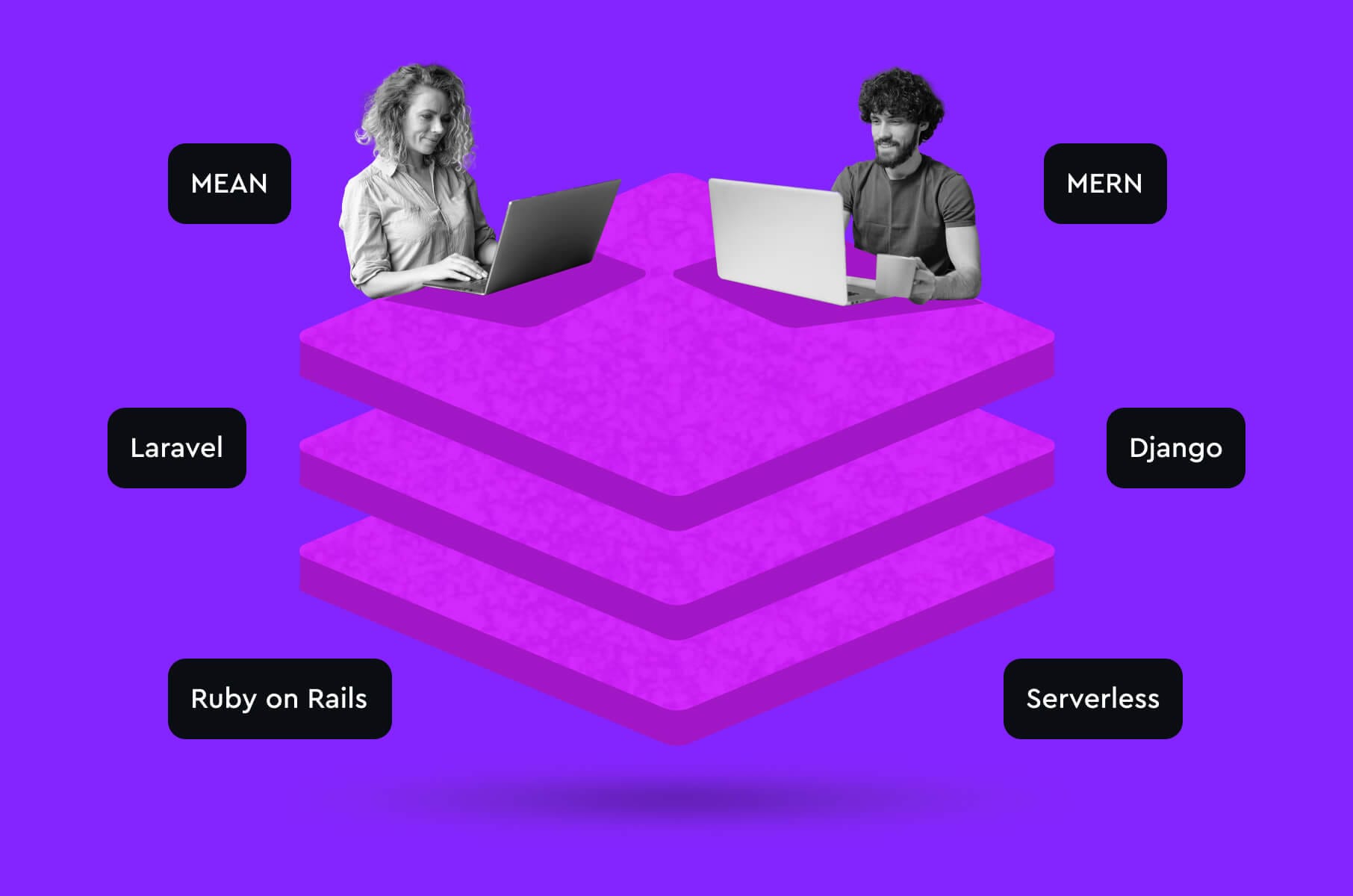
Choose your SaaS MVP tech stack around the workflow you need to prove, the data it handles, its integrations, and the team that will maintain it. Start with those constraints, then compare ways to build. There is no single best tech stack for SaaS: a choice that suits an approval tool may create unnecessary work for a collaborative editor.
A SaaS tech stack is the combination of languages, frameworks, databases, and infrastructure used to run your software. The frontend handles the interface; the backend handles application logic, data, and connections to other systems.
The decision should cover your first release and the changes you might need after validation. This guide compares four approaches through a decision matrix and product scenarios. Use it to prepare a shortlist and identify what the team needs to verify before committing to an implementation.
Start with the product, not a framework
Describe one complete user task before discussing technologies. For an approval product, that might be: an employee submits a request, a manager approves it, and the decision becomes visible to the right people. That description raises useful technical questions. Can a request change after approval? Who can see attachments? What happens when the manager leaves the company?
Start with the part of the workflow you have yet to demonstrate. What has to work for someone to use the product again? Keep that uncertainty visible while you work through the technical constraints.
For required integrations, identify the outside systems that must exchange data with the MVP. Check whether the team can access their documentation and test environments. Describe the data you will store and who may change it, including what happens to a customer's records when they leave.
Estimate the first release's workload, marking assumptions as such. Include simultaneous activity and background work where the task requires them. Then assign responsibility for operating the application after handoff. Someone needs to deploy changes and investigate failures, no matter which stack you choose.
If the core task is still unsettled, first decide what to build in your MVP. A framework comparison cannot resolve a disagreement about the product's purpose.
Distinguish launch requirements from requests you can defer. “Customers need to export their records” is a requirement you can test. “We might eventually need every integration” is too broad to guide an architecture decision.
Four ways to build a SaaS MVP
These approaches describe how you divide implementation and maintenance work. They can overlap: a starter kit may use a managed backend, while a full-stack application may delegate a specific task to another service. Compare the arrangement your team would actually deliver.
Managed backend/BaaS plus a web framework. Backend as a service means using a provider for selected backend functions while your team builds the application around them. Consider it when those functions match your requirements and you can work within the provider's boundaries. A candidate combination to verify with the team is Next.js with Supabase. The decision still needs an owner for access rules, data changes, monitoring, and recovery; choosing a provider does not settle those responsibilities.
Full-stack framework with a relational database. Keep the application together, using a framework for its structure and a relational database for related records. Consider this when the team knows the framework and wants to implement business rules in one application. Examples to verify with the team include Django with PostgreSQL or Laravel with MySQL. Assess the actual workflow, deployment plan, and maintenance skills before choosing between them.
SaaS starter kit or boilerplate. Begin with an existing application foundation and adapt it to your product. This fits when the supplied patterns resemble what you need and the team can understand and maintain the code. MakerKit and supastarter describe themselves as SaaS starter kits. Wasp is a full-stack framework, while create-t3-app sets up a T3 application; neither label alone tells you whether your SaaS requirements are covered. Inspect the current product and version, rather than treating these names as interchangeable packages.
Custom service architecture. Separate parts of the product into services with their own responsibilities and deployment. Consider this when a demonstrated workload, integration, or isolation requirement warrants the additional coordination. It is usually a decision to revisit after validation. For example, a separate Python processing service might be a candidate for an application with a specialized workload, but the team must justify that boundary and explain how failures will be handled.
SaaS MVP tech stack decision matrix
Use this matrix to compare a tech stack for an MVP against its constraints. Each cell describes a fit condition and a tradeoff to investigate. Examples above are candidates to verify with the team, not endorsements of a vendor or plan.
| Decision criterion | Managed backend/BaaS + web framework | Full-stack framework + relational database | SaaS starter kit or boilerplate | Custom service architecture |
|---|---|---|---|---|
| Product type / core workflow | Consider it if the provider's model supports the task. Check how much custom work the business rules require. | Suits a workflow whose related records and rules can stay in one application. Keep the business logic organized enough to change. | Useful if the supplied account patterns resemble your product. Extensive changes to the foundation may outweigh the head start. | A distinct requirement may warrant a service. Defining boundaries before understanding the workflow risks unnecessary separation. |
| Realtime and data workload | Use a tested configuration that meets the update and data needs. Investigate consistency limits and recovery behavior. | A candidate if the application and database can handle the workload. Examine concurrent edits and long-running work. | Check that its data model supports the required updates. Sample code may hide assumptions your product cannot accept. | Independent processing or isolation may justify this approach. Account for synchronization and partial failures. |
| Integrations | Required connections must work within the provider's constraints. Establish who manages retries and credentials. | Consider it when integrations can run within the application. Keep external failures from leaving user requests unresolved. | Supplied integrations help only if they cover your use cases. Inspect error handling and any unsupported variations. | A connector may need its own lifecycle. Check how repeated events and cross-service coordination will be handled. |
| Launch speed | A candidate once the team has verified the core task. Include learning time and restrictions found during the check. | Familiarity with the framework and deployment can support this choice. Unfamiliar tooling still needs learning and verification. | Compare adaptation with building the required foundation yourself. Time spent undoing its assumptions belongs in that estimate. | Separation can be useful when it resolves a demonstrated obstacle. Include the extra deployment and debugging work. |
| Maintenance and operational load | Fits an arrangement with explicit provider and team duties. Assign backups, access-rule maintenance and usage monitoring. | Needs an owner who can maintain the application and infrastructure. Check upgrade plans and test recovery. | The team must be able to maintain its fork. Assess how customizations affect upstream dependency updates. | Choose it only with capacity to operate each service. Make incident ownership clear across service boundaries. |
| Hiring availability | Future maintainers need the framework and provider model. Check experience beyond tutorials. | Assess whether your hiring market has maintainers for the chosen stack. Reliance on one specialist remains a support risk. | Maintainers must understand the underlying technologies. Check how much knowledge is held only by the starter's author. | The team needs coverage for each language and service boundary. Fragmented expertise can complicate support. |
| Post-validation scale and likely change | Consider continued use if the next workload can be tested within the platform. Check export options and provider-specific logic. | Stay with it if measured bottlenecks can be addressed in the application. Identify the constraint before splitting services. | A candidate if the code can evolve beyond its original assumptions. Check whether customization blocks necessary upgrades. | Independent changes or workloads can justify separation. Weigh that benefit against the continuing coordination work. |
Start with the rows that could make an approach unusable for your product. Record evidence, an unresolved question, and an owner for each of those rows. Reject an option that fails a requirement rather than offsetting the failure with several attractive features. Compare the remaining options on implementation effort and who will maintain them.
Consider a hypothetical team with two engineers and one month to launch an approval tool. Both engineers know the same full-stack framework; nobody has tested the proposed managed backend's permissions model. The familiar framework is a reasonable starting candidate if it supports the workflow. A managed backend or starter deserves consideration if a short test demonstrates less work without compromising access rules. The deadline calls for a bounded comparison; it does not prove that any named stack can deliver the product within a month.
Four product scenarios and the question to resolve
Content or workflow SaaS
Consider a product for drafting, reviewing, and approving customer documents. Its screens may be straightforward, but its rules need attention: who owns a document, who can approve it, which version was approved, and whether an approval can be withdrawn.
A full-stack application, a managed backend, or a suitable starter could each be a candidate. Test the relationships and permissions before choosing. For a micro-SaaS run by a solo founder, include the work you will personally own after release, such as restoring data or investigating a failed notification.
The question is whether the approach can express those rules in a place the team can maintain. If an approval rule has to be repeated in several screens and administrative scripts, ask how a future change will reach every copy. Walk through an exception as well as a successful approval before accepting the design.
Integration-heavy B2B SaaS
Imagine a product that imports CRM records, checks them, and sends approved updates to an accounting system. Its usefulness depends on the entire round trip. An integration demo that transfers one record does not show what happens when access expires, the external API is unavailable, or the same event arrives twice.
For this B2B SaaS tech stack, compare approaches using the required integration's behavior. Give long-running work a defined execution path, and decide how users will see progress or retry a failure. A separate connector service is one option if its requirements justify it; it is not the automatic starting point.
Ask the team to demonstrate recovery from an interrupted transfer. It should be clear which records arrived and whether retrying would apply a change twice. Follow that recovery through the user interface as well: a maintainer may understand the failure while the customer still sees an apparently successful update.
Realtime or collaborative product
A dashboard that refreshes periodically and a document that several people edit simultaneously have different requirements. Specify the interaction before requesting “realtime.” What should another user see, how soon should they see it, and what happens after a connection drops?
Compare candidates with a small demonstration of the actual interaction. Include two users changing the same item, a reconnect, and a user losing access while the page remains open. Do not infer correct collaboration from the presence of a realtime feature in a product description.
Agree on what the intended result should be when updates conflict or arrive late. Then check the demonstration against that rule. The stack decision needs evidence that the proposed design can preserve it, including after a reconnect, rather than a feature name on a checklist.
Data-sensitive or rules-heavy product
For a product handling sensitive records or consequential approvals, begin with a data-flow description. Identify what enters the system, where it is stored, which services receive it, and who can access it. Define deletion, retention, recovery, and audit requirements with the people responsible for them.
Compare each architecture against those requirements. Neither managed infrastructure nor custom code establishes compliance on its own. Verify applicable requirements, contracts, configuration, and operating procedures before making a claim about suitability. A small first release still needs the controls required for the data it actually handles.
For each consequential action, ask who is permitted to perform it and how the team would reconstruct what happened afterward. Review the answer against the required record history. If the candidate leaves a gap, identify whether configuration can close it or whether the architecture needs to change.
An AI feature adds questions to all four scenarios: what data leaves the application, what counts as an acceptable response, what happens when a request fails, and whether a person must review the result. Test that feature within the user workflow before adopting a separate AI architecture. If the assumption itself is unclear, choose an appropriate way to test it before committing to the build.
What this looks like in practice: a Merge example
The Waffly case study documents an audio product with AI and semantic search requirements. Its published stack is:
No-code chatbot, Node.js, Typescript, Mongo DB, GraphQL, React (Next.js + Tailwind), Jira + Notion (PM), SCRUM process setup, VOSK API library, Pyannote-audio
That list includes project-management tools alongside technologies. The audio-processing components are relevant to the product's particular task; copying only its web framework would not reproduce the implementation.
The case study reports: “Successfully shipped a Proof of Concept (POC) within a month.” It also identifies “Three months for MVP.” Val Wikstrem, CEO at Waffly, describes the sequence:
“Achieving the delivery of a POC within just one month helped us to fundraise our angel round and begin to work on the complete MVP. Within three months through the help of Merge was a remarkable success in my view.”
These are the project's reported outcomes and the client's account of them. They do not establish a delivery schedule or fundraising result for another product.
For a different example, Promtify is Merge's own AI template builder, not a client project. Its published technology list is “Next.js, Supabase, Vercel, OpenAI API,” and its reported milestone is “MVP launch in two months.”
Read these cases as examples of different combinations used for particular products. They do not provide a controlled comparison between approaches, and neither case establishes that its technologies would be faster for your team. Your decision still needs evidence about your workflow and constraints.
How to make the decision with your team or partner
Begin the discussion with the product's requirements. Explain the core workflow and the first release's boundaries, including data types and required integrations. Identify who is available to build and support it. Acceptance conditions written in user terms make the discussion easier to assess: “A reviewer sees the approved version” gives the team something to check. Resolve competing scope requests through MVP feature prioritization before comparing implementations.
Where a requirement remains uncertain, use a technical spike: a small experiment aimed at a defined question. For an integration, that might mean recovering from an interrupted transfer. For a collaborative product, it might mean resolving concurrent edits. Give the experiment a stopping condition and record what it showed, including any failures. Agree whether its code will be discarded or needs further work before entering the product.
Write the choice in an architecture decision record, or ADR. Someone joining the project should be able to read it and understand which options were considered, why some were rejected, and what tradeoffs remain. Include the evidence from the spike. An unresolved assumption deserves its own entry so it cannot disappear into a general statement that the stack is suitable.
Use the same record to make operating responsibilities explicit. Name who will handle deployments and dependency updates. Assign incident response and data recovery, checking that the responsible people have the necessary access. Describe how application data can be exported and which parts would need work if a provider were replaced. A future maintainer needs to understand the consequences of that choice.
Finally, agree when to revisit the decision. A pilot may reveal a different workflow; a confirmed customer requirement may expose a missing capability. Choose a trigger relevant to your product and say what evidence would warrant a change. “Reconsider after validation” is too open-ended to guide a review. A named trigger lets the team keep using a suitable stack while remaining ready to examine a specific constraint.
Use the same scope when comparing estimates, including testing, deployment, maintenance, and handoff. The MVP development cost guide explains how to read those assumptions. A low infrastructure estimate alone does not describe the effort required to build and operate the application.
If you need a partner for this work, review how Merge approaches scoping and building a first release. Bring the unresolved decisions so the discussion can address technical fit before committing to an implementation.
What to avoid
A familiar technology can earn a place on the shortlist without settling the choice. Ask the person recommending it to connect the recommendation to your workflow. Which requirement does it address, and what work will still fall to your team? Experience with the technology is useful input, provided someone checks its fit for this product.
Watch for services added to accommodate a scale the product has not demonstrated. Each proposed boundary needs an explanation of how it will be deployed and what happens when it fails. Ask what present requirement makes the separation worthwhile. Keep the first version understandable enough for its maintainers to trace a failed task through the application.
Examine dependencies before relying on them. Review licenses and update history, then check the documentation and data-export options. Discuss the consequences of an outage and who will respond to a provider change. An option that looks replaceable on a diagram may still require substantial migration work once product logic depends on it.
A stack also needs a maintainer beyond its original developer. Ask the person who will receive it to explain the code structure and release procedure. Note where they need more context, and document account ownership before handoff. The exercise can reveal a support gap while there is still someone available to explain the implementation.
Before rebuilding routine functions such as authentication or payment handling, compare existing options against your requirements. Check what adopting one would involve, including configuration and testing. If the team recommends custom implementation, ask which requirement warrants that work. A preference for full control needs to be weighed against the responsibility for operating the result.
FAQ
What tech stack should I use for my MVP?
Shortlist approaches that support the core workflow, required integrations, and data rules, then compare them against your team's experience. A SaaS MVP tech stack decision should explain why the option fits now, who will maintain it, and what would make you revisit it. Use a small technical test where an unresolved requirement could change the answer.
Should we start from a SaaS starter kit or boilerplate?
Consider one when its existing patterns match your product, and your team can maintain the underlying code. Inspect account boundaries, billing assumptions, error handling, deployment, and the update path. Estimate both the work saved and the work needed to remove unsuitable assumptions. Treat a framework, an application scaffold, and a SaaS starter as different starting points, even if they appear in the same recommendation list.
Is the most popular tech stack the safest choice?
Popularity does not establish security or suitability. It may help you find documentation or candidates, but verify the skills available in your hiring market and the project's current maintenance practices. Ask the team to demonstrate access controls, dependency management, and recovery for your application. Those checks are more useful than choosing by a popularity ranking whose audience may differ from yours.
When should we revisit the stack after validation?
Revisit it when observed usage, a confirmed requirement, or a change in team ownership challenges an assumption recorded in the decision. First identify whether the constraint concerns configuration, application design, infrastructure, or a specific component. A PoC usually precedes an MVP when technical feasibility is the open question; a later technical spike can examine a newly discovered uncertainty. Change the parts the evidence points to, rather than assuming validation calls for a rewrite.
Discuss your core workflow with Merge, including any requirements you haven't yet verified. We can work through the implementation options with your team before you commit to a SaaS MVP tech stack.