0
Table of Contents
What is the best front end framework in 2026? (Expert breakdown)
Choosing the right front-end framework for your product impacts speed, cost, flexibility, and how easy it is to find builders.

TL;DR – quick answer
There is no single best front-end framework in 2026 — there is a best fit for your product, your team, and your hiring budget. Before you pick a stack, it helps to be clear on what a front-end framework is and what problem it actually solves for you.
As a starting point:
- React — if you want the broadest public usage signal and the largest number of ready-made integrations, libraries, and framework options (Next.js, React Router, Expo).
- Angular — if you're running a large team that benefits from strict conventions, a batteries-included toolchain, and less architectural debate.
- Vue — if you want gradual adoption on an existing codebase and a faster onboarding curve for new developers.
- Svelte, SolidJS, or Preact — if your team accepts a smaller public usage signal in exchange for a specific, documented performance or bundle-size requirement.
- jQuery — only to maintain existing legacy code. Not a reasonable choice for a new product build in 2026.
These are decision-guidance starting points, not an empirical ranking. Every adoption, version, security, or performance claim below is paired with a primary source — check the source, not just our summary, before you commit.
How we picked winners – methodology
This breakdown combines four types of signal, not a single ranking:
- Adoption signal — usage share from the Stack Overflow 2025 Developer Survey and interest trends from State of JS 2025. Survey usage is a proxy for how many developers already know a technology — it is not hiring-market data, and it does not prove that hiring will be faster or cheaper for any given framework.
- Maintenance status — whether the project has an active maintainer team, a recent major or minor release, and a public roadmap.
- Rendering options — whether the framework has a first-party or well-supported path to server-side rendering (SSR), static generation, or an app-level framework, since this affects SEO-relevant technical capability (not SEO outcomes on its own).
- Learning and migration cost — how much a team already familiar with JavaScript and one of these frameworks needs to relearn to be productive, and how disruptive a future migration away from the choice would be.
We did not run our own performance benchmarks for this piece. Where we describe performance characteristics, we describe documented mechanisms (compilation, reactivity model, bundle size) rather than measured numbers, and we link to the primary source.
Which frontend framework is best in 2026? What are we looking for
Picking a framework is a set of trade-offs, not a scorecard. Here's what each criterion actually changes for your product.
Development speed
This is how quickly a team can go from a blank repository to shipping real features. It's driven less by syntax and more by ecosystem maturity: how many solved problems (routing, forms, data fetching, auth) already have a well-documented library or first-party solution, and how much your team already knows the framework's conventions. A framework with a large ecosystem cuts the number of decisions a team has to make before writing product code.
Scalability
Scalability here means how the codebase holds up as your team and your product both grow — more contributors, more routes, more shared state, possibly more than one app sharing a design system. This is shaped by how opinionated the framework is about architecture, how mature its state-management options are, whether it has a documented path for splitting a large app into smaller, independently deployable pieces, and how much of the ecosystem's tooling supports automated front-end testing as the codebase gets bigger.
What are the hiring-market realities in 2026
The framework you pick correlates with how many developers already know it, and public usage-share data — the Stack Overflow survey and State of JS interest trends — is the closest public proxy we have for that. It is not a hiring-market study: neither source tracks time-to-hire, salary data, or contractor availability by region, so treat usage share as a directional signal, not a guarantee about how fast or cheap hiring will be. If your hiring plan depends on a specific timeline, validate against your own recruiting pipeline or an IT hiring services partner before committing to a framework on hiring grounds alone.
Performance
Performance depends on the framework's rendering model — virtual DOM diffing, compile-time optimization, or fine-grained reactivity — and on how the app is built on top of it (code splitting, image handling, server rendering). We describe these mechanisms as documented by each framework's maintainers; we did not run a standardized cross-framework benchmark for this article, so we avoid claims like "fastest" or "best performance" without a reproducible test behind them. If performance work is already a priority for you, see our practical guide to optimize React app performance.
Cost
Cost mainly comes down to three things: the cost of hiring or contracting for the skill, the cost of maintaining the codebase over time, and the cost of migrating away from the choice later if it stops fitting. A framework that's slightly slower to hire for but cheaper to maintain can still be the lower total-cost option. Part of this decision is also whether you build the team in-house or bring in outside help — see our take on outsourcing front-end development if that trade-off is still open for you.
2026 update: what changed since 2025
A few concrete, verifiable changes since last year's version of this article:
- React stays on the 19.x major line, with 19.2 as the current minor version; the current listed patch as of August 31, 2026 is 19.2.7. (react.dev/versions)
- Angular v22 shipped on June 3, 2026, moving Signal Forms, Angular Aria, and asynchronous reactivity work further toward the framework's default, opinionated toolchain. (Angular v22 announcement)
- Vue — 3.5.x is the current stable line; Vue 3.6 remains a pre-release. (Vue core releases)
- React's own documentation now recommends Next.js (App Router), React Router v7, or Expo for new apps — Remix is no longer listed as a separate current recommendation. (react.dev/learn/creating-a-react-app)
- SolidStart v2 is marked stable on the official SolidStart site. (start.solidjs.com)
- jQuery 4.0 shipped in January 2026 — its first major release in nearly a decade — and drops support for IE 10 and older, along with several other legacy browser targets. (jQuery 4.0.0 release notes)
None of these releases changes our underlying guidance: pick based on your product, team, and hiring constraints, not on which framework shipped most recently.
Decision matrix (2026): pick in 60 seconds
This table compares fit, not unverified scores. It does not declare a single "best," "fastest," or "cheapest" option, because no reproducible, identical benchmark exists across all seven for this article.
Option | Good fit when | Main trade-off | Maintenance/adoption signal | SSR or app-framework path |
React | You want the broadest public usage signal and the most mature ecosystem of libraries and frameworks | Framework choice on top of React (Next.js, React Router) adds another set of decisions and version dependencies | Highest usage share in the Stack Overflow 2025 survey among the frameworks compared here | Next.js (App Router), React Router v7, or Expo |
Angular | You run a larger team that benefits from enforced structure and a single opinionated toolchain | Steeper initial learning curve; less flexible for teams that want to pick their own state and routing libraries | Actively maintained with a regular major-version cadence; v22 shipped June 2026 | Built-in SSR support via Angular's own tooling |
Vue.js | You're adopting incrementally on an existing site, or want faster onboarding for developers new to the framework | Smaller ecosystem and public usage signal than React; 3.6's larger reactivity changes are still in release candidate | Stable 3.5.x line with active development; usage share below React and jQuery in that same survey | Nuxt for SSR/static generation |
jQuery | You are maintaining an existing legacy codebase that already runs on it | Not designed for building new component-driven applications; 4.0 dropped support for older browsers, which can matter for legacy audiences | Still measurably used per that same survey, but not a framework anyone should choose for new product builds | None — no modern SSR/app-framework path |
Preact | You need a much smaller runtime footprint and can accept a leaner API surface | Provides React compatibility through preact/compat, but has documented differences from React that can surface in larger apps using less common React APIs | Smaller adoption than React, Angular, or Vue; actively maintained | Works with static-site and SSR setups built around it, without React's own framework ecosystem |
Svelte | You want a compiler-driven approach that shifts work from the browser to build time | Smaller public usage signal; "less runtime code shipped to the browser" is a documented design goal, not a guarantee of zero runtime cost in every app | Active development, notably lower usage share than React or Angular in that same survey | SvelteKit for SSR and app-level routing |
SolidJS | You want fine-grained reactivity performance characteristics without a virtual DOM | Smaller public usage signal than the other six; fewer third-party libraries than React or Vue | SolidStart v2 is now marked stable, which removes a prior maturity gap | SolidStart for SSR and app-level routing |
Best front end framework in 2026: our expert list
React
React is a UI library maintained by Meta and an active open-source community, most often used today through a full framework built on top of it rather than on its own.
When it fits: Teams that want the broadest public usage signal, the largest set of third-party libraries, and flexibility to choose their own framework layer (Next.js, React Router, Expo, or others).
Main trade-off: Because React itself is just the UI layer, teams need to choose and maintain a framework or toolchain on top of it, which adds an extra layer of decisions and upgrade cycles.
Current status: React 19.2 is the current minor version, with 19.2.7 the current listed patch as of August 31, 2026 (react.dev/versions). It's worth noting that React Server Components have had a documented security history: an initial critical RSC vulnerability was patched, and subsequent RSC-specific issues required further patches after that first fix (Dec 3, 2025 advisory, Dec 11, 2025 advisory). If your app uses RSC-based packages or frameworks, keep them on the current patched release line rather than treating any single past patch as a permanent fix.
Related path: For teams building product UI on React, our guide to building efficient React interfaces covers patterns beyond the framework choice itself. React's own documentation currently recommends Next.js (App Router), React Router v7, or Expo for new apps.
Angular
Angular is a full application framework maintained by Google, built around TypeScript, dependency injection, and a single opinionated toolchain for routing, forms, and HTTP.
When it fits: Larger teams and longer-lived enterprise applications where consistent conventions across contributors matter more than flexibility to swap individual pieces.
Main trade-off: The learning curve is steeper than React or Vue for developers new to the framework, and Angular's opinionated structure gives teams less freedom to pick alternative state-management or routing approaches.
Current status: Angular v22 shipped on June 3, 2026 (Angular v22 announcement).
Related path: Angular ships its own SSR tooling as part of the core framework, so there isn't a separate third-party app-framework decision to make in the way there is with React.
Vue. js
Vue.js is a progressive framework maintained by Evan You and an independent open-source team, designed to be adopted incrementally.
When it fits: Teams adding interactivity to an existing site rather than starting a fully component-driven app from scratch, and teams that want new developers productive quickly.
Main trade-off: Vue's ecosystem and public usage signal are smaller than React's, and the larger reactivity changes coming in Vue 3.6 are still in release candidate, not yet the recommended production version.
Current status: Vue 3.5.x is the current stable line; Vue 3.6 remains a pre-release. (Vue core releases)
Related path: Nuxt is Vue's equivalent to Next.js for SSR and static generation, for teams that need it.
jQuery
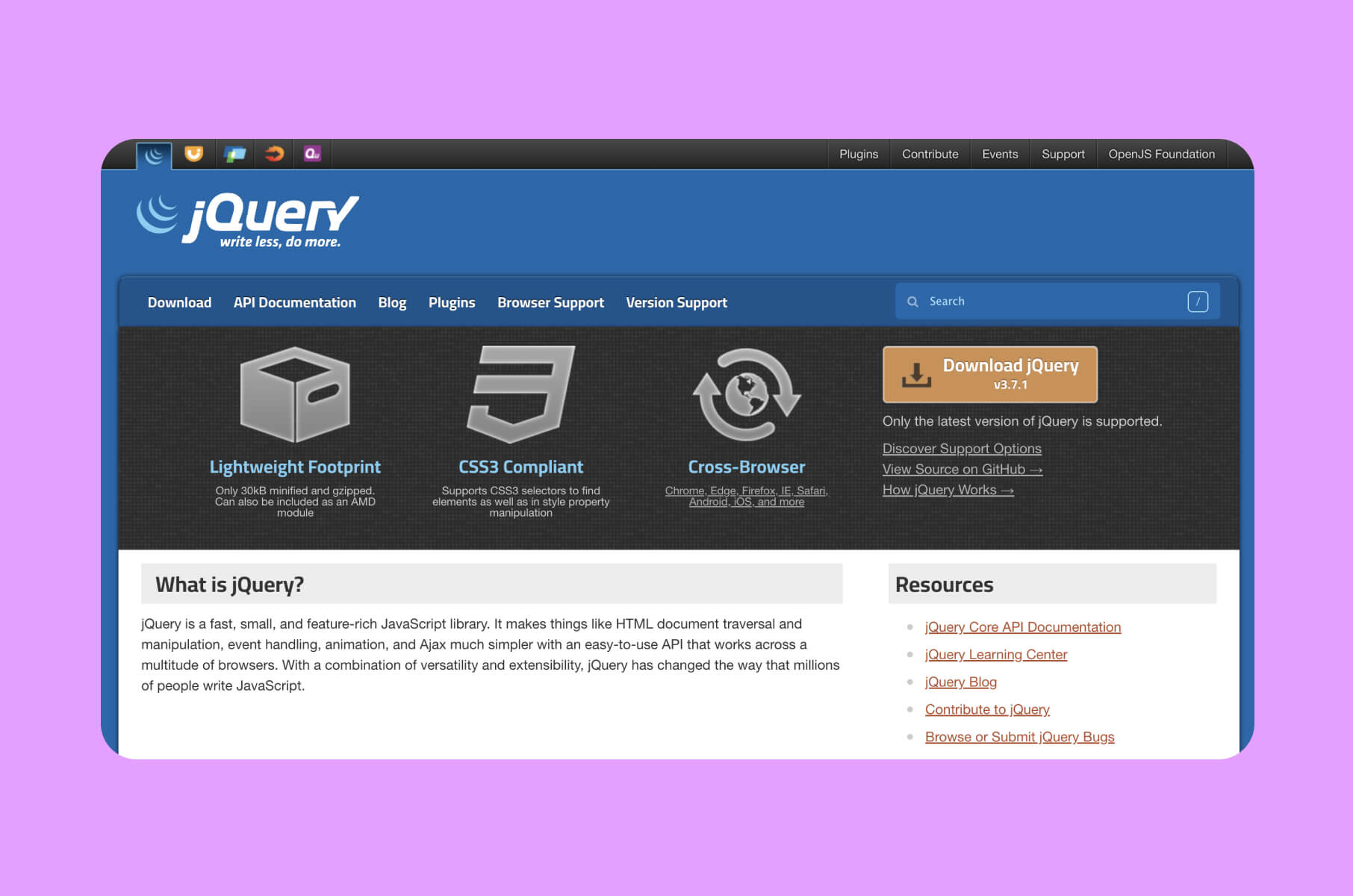
jQuery is a DOM-manipulation and utility library, not a component framework, now in its 20th year and maintained by the OpenJS Foundation.
When it fits: Maintaining an existing site or application that already depends on it. It is not a reasonable choice for a new product build.
Main trade-off: jQuery has no component model, no built-in state management, and no modern rendering approach — it solves DOM problems that most current frameworks solve differently and more comprehensively.
Current status: jQuery 4.0 shipped in January 2026, its first major release in nearly a decade, and it drops support for IE 10 and older along with several other legacy browser targets (jQuery 4.0.0 release notes). Teams that still need to support those older browsers need to stay on an earlier jQuery branch rather than upgrading.
Related path: Not applicable – jQuery has no SSR or app-framework layer.
Preact
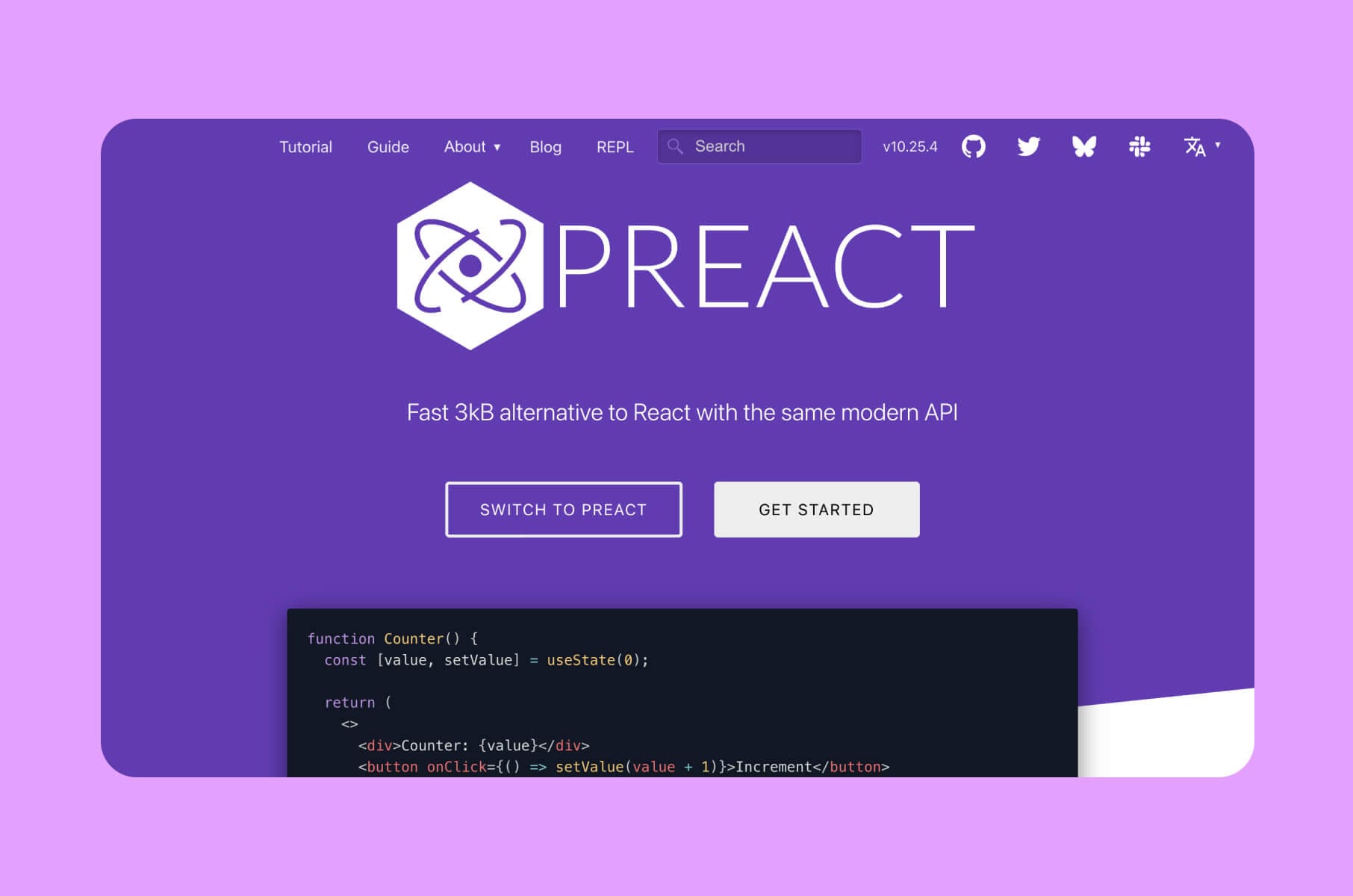
Preact is a lightweight alternative to React, maintained by an independent open-source team, built around a much smaller runtime.
When it fits: Projects where bundle size and runtime footprint are a hard constraint — for example, embeddable widgets or performance-sensitive marketing pages — and the team can work within a leaner API surface.
Main trade-off: Preact provides React compatibility through its preact/compat layer, but it has documented differences from React, which can surface if an app leans on less common React APIs or on libraries that assume full React internals.
Current status: Preact continues active maintenance with a materially smaller adoption base than React, Angular, or Vue.
Related path: Preact is typically paired with static-site or SSR setups built specifically around it rather than React's own framework ecosystem.
Svelte
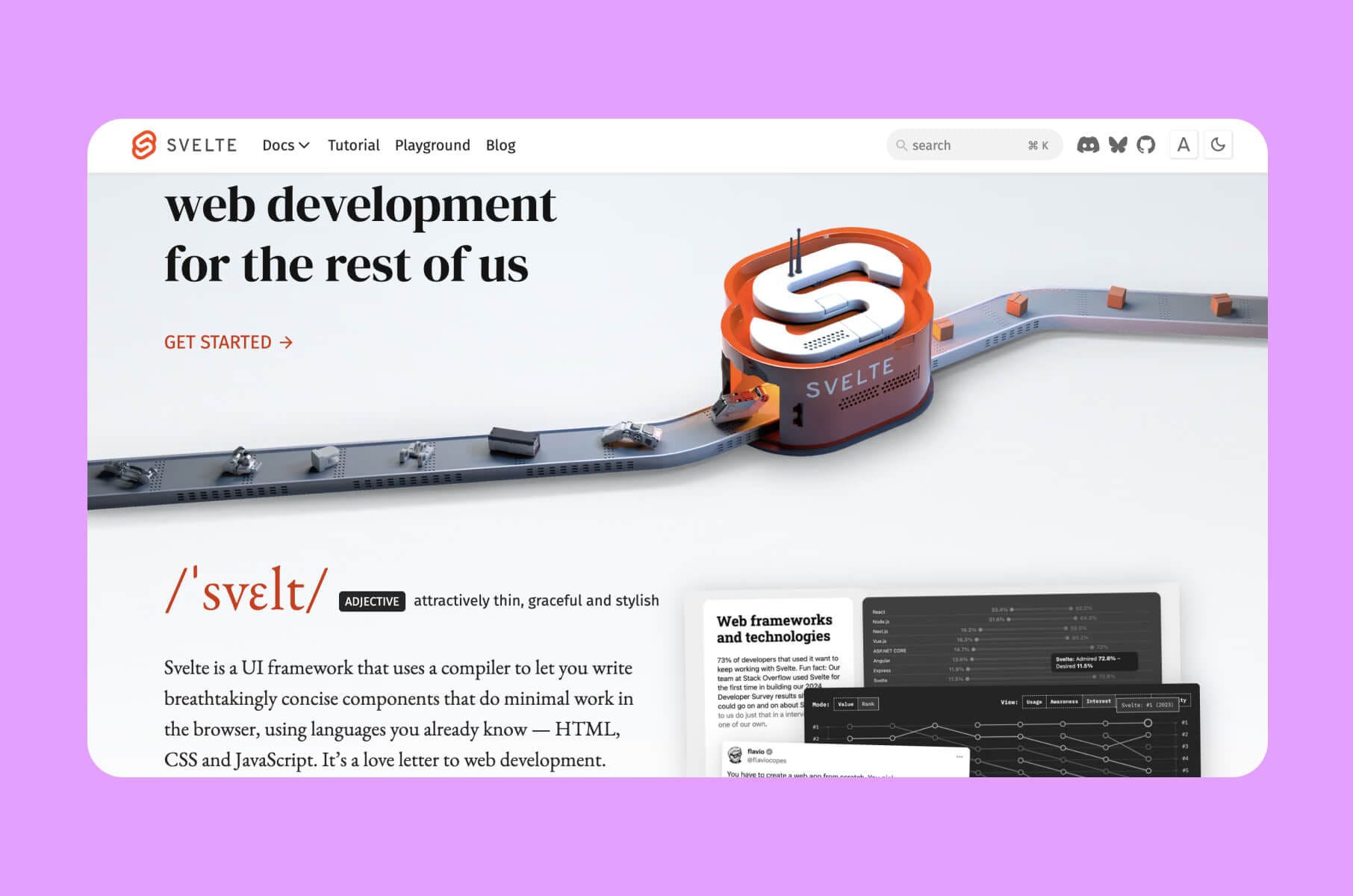
Svelte is a compiler, maintained by its core team, that shifts substantial framework work to build time; its apps can still ship runtime code.
When it fits: Teams that want a compile-time approach to reactivity and are comfortable with a smaller public usage signal and ecosystem than React, Angular, or Vue.
Main trade-off: Svelte's compiler moves work that other frameworks do at runtime into the build step, but this is a documented design goal, not a claim that runtime overhead is zero — Svelte apps still ship some runtime code for reactivity and DOM updates. (Svelte 5 announcement)
Current status: Svelte 5's Runes reactivity model remains the current approach, with active ongoing development.
Related path: SvelteKit is Svelte's app framework for SSR and routing.
SolidJS

SolidJS is a fine-grained-reactivity library maintained by its core open-source team, often compared to React in API shape but built on a different reactivity model under the hood.
When it fits: Teams that specifically want fine-grained reactivity performance characteristics without a virtual DOM, and can accept a smaller public usage signal than the other six options here.
Main trade-off: SolidJS has fewer third-party libraries and a smaller community than React, Angular, or Vue, which can mean more custom work for common problems.
Current status: SolidStart v2 is now marked stable on the official SolidStart site, which resolves what had been an open maturity question for Solid's app-framework layer. (SolidStart v2 discussion, start.solidjs.com)
Related path: SolidStart for SSR and app-level routing.
What is the future of front end?
A few directions are visible across the frameworks covered here, without predicting a single winner:
- Full-stack, SSR-first frameworks are the default entry point where SSR is needed. React and Solid now point new users toward an app-level framework (Next.js/React Router/Expo, SolidStart) for new apps generally. Vue's own guidance is narrower: it recommends reaching for a framework like Nuxt specifically when an app needs server-side rendering, not as a default for every new Vue project. (Vue SSR guide)
- Fine-grained reactivity is spreading beyond Solid. Svelte's Runes model and Vue's in-progress 3.6 reactivity work both move away from broader virtual-DOM diffing toward more targeted updates.
- Compilers are doing more of the work. Svelte's compile-time approach, and compiler-assisted optimizations elsewhere in the ecosystem, are shifting some performance work from runtime to build time.
- Frameworks are shipping stronger defaults. Angular v22 made OnPush-oriented defaults and built-in primitives like Signal Forms part of its default toolchain, part of a broader trend toward opinionated, batteries-included setups. (Angular v22 announcement)
We aren't going to predict whether AI tooling changes how much front-end code humans write day to day — we don't have a primary source that settles that, so it's out of scope here. And to be clear, none of this future-facing context changes the use-case guidance in the TL;DR above.
FAQs
Which frontend framework is best overall in 2026?
There isn't one. React has the broadest public usage signal and ecosystem; Angular fits larger, convention-driven teams; Vue suits incremental adoption; Svelte, SolidJS, and Preact fit teams with a specific performance or bundle-size need and a smaller public usage signal they're comfortable with; jQuery is for legacy maintenance only. Match the framework to your product and team constraints using the decision matrix above.
React vs Vue: which is better for a startup?
It depends on your team's existing skills and how much of your product is already built. React has a broader public usage signal and more third-party options; Vue is often faster to onboard new developers onto and easier to adopt incrementally on an existing codebase. See Related reading below for a deeper look specifically at this comparison for startup teams.
Which frontend framework is easiest to hire for?
By usage share in the Stack Overflow 2025 survey, React and jQuery have the largest publicly reported developer populations among the frameworks compared here, followed by Angular and Vue. That's a usage-share signal, not a confirmed guarantee of hiring speed or cost — see the hiring-market realities section above for how to validate it against your own recruiting pipeline.
Which framework setup is best for SEO?
No framework guarantees better SEO on its own. What matters is the rendering setup (SSR or static generation), crawlability, page performance, and content quality built on top of the framework. See Next.js vs React for SEO for a closer look at one specific rendering setup.
Which framework is best for dashboards and large internal products?
Angular's built-in conventions and tooling tend to suit larger internal teams building long-lived, contributor-heavy applications. React with a mature state-management setup is also a common choice when the team already has React experience.
Is jQuery still relevant in 2026?
Only for maintaining existing code that already depends on it. jQuery 4.0 (January 2026) dropped support for IE 10 and older, and it isn't designed for building new component-driven applications — it isn't a reasonable choice for a new product build.
Are Svelte, SolidJS, and Preact mature enough for production?
Yes, with the caveat that all three have a smaller public usage signal and ecosystem than React, Angular, or Vue. SolidStart reaching stable v2 and Svelte 5's active development both indicate ongoing investment; the trade-off is fewer available developers and third-party libraries, not framework immaturity.
Related reading
If you're weighing this same decision for a smaller team, our narrower comparison of React vs Vue vs Svelte for startups goes deeper on those three specifically.
Summary
The right framework depends on your product, your team's existing skills, your hiring plan, and how much migration risk you can absorb – not on which option is newest or most talked about.
As a decision path:
- Pick React for the broadest public usage signal and ecosystem;
- Pick Angular if you need enforced structure for a larger team;
- Pick Vue for incremental adoption and faster onboarding;
- Pick Svelte, SolidJS, or Preact if you have a specific performance or bundle-size requirement and accept a smaller public usage signal;
- Keep jQuery only for legacy maintenance.
When Merge worked on Restream's front end, the result was new pages, more predictable releases, controlled campaigns during Black Friday/Cyber Monday, and a site that's now easier to evolve and update – see Restream front-end work. That result reflects delivery quality, not a specific framework choice, and it isn't a ranking, SEO, or traffic guarantee.
If you've chosen a stack and need a team to build it, our front-end development services team can help you scope and deliver the work.